
Ambassador, you're really spoiling us!

When I was about seven years old, we moved to a town called Mbeya, in south Tanzania. At the time, in the mid 1980s, there was no school there suitable for me. This was not a fact that seemed to overly trouble my parents, and certainly caused me no distress at all. I was not the hugest fan of school, and had been quite delighted with myself when shortly before the move to Mbeya, my parents had been asked to remove me from the Canon Andrea Mwaka school in Dodoma, due to my bad behaviour. With hindsight, this seems a little harsh on a seven year old, especially since my behaviour largely stemmed from boredom, and a refusal to sit down and read the excruciatingly tedious Peter and Jane books they insisted could be the only measure of my reading ability, far preferring the delights of the Famous Five and the Islands of Adventure etc. A couple of years later, we returned to Dodoma, and to my dismay, I was returned the Canon Andrea Mwaka school, where I behaved no better, and got in repeated trouble for fighting. I still harbour a grudge over the beating I got from the head teacher for scrapping with a boy called James in the year below- apparently the fact he both started it and deserved it was not considered a suitable defence for battering a (very slightly) younger child. I am also still bitter that he got the last punch in. But that is neither here nor there.
In the interlude between the unhappy periods at the hands of the Anglican missionaries in charge of the Canon Andrea Mwaka school, there was a blissful period in Mbeya. Mbeya was magical. We lived in a square white house, slightly above the town, set in huge green gardens. There were chickens, and a vegetable patch filled with peas and strawberries and two dogs- Bozo, a (mostly) Rhodesian Ridgeback, and Boona, a sweet girl of indeterminate parentage.
There were two other houses in the compound- the furthest house was occupied by a pair of American nurses who ran some sort of clinic, and next door to us lived a Texan family called the Boyles. Ralph Boyle was my age, and his sister Amanda was a couple of years older than us. Amanda Boyle was the most glamourous creature I had ever encountered. She had an extensive Barbie collection, including, to my lifelong envy a swimming pool for her Barbies, and she had a Girl’s World make up head, AND AS IF THAT WASN’T ENOUGH, Amanda had an actual waterbed. I was awestruck with wonder at such a thing. Mr Boyle, being Texan, had a lot of guns and liked shooting things, which was more useful and less bloodthirsty than it sounds, because he was a frequent source of fresh meat when such things were in short supply in 1980s Tanzania (pretty much everything was in short supply in 1980s Tanzania to be honest). Mr Boyle’s passion for shooting things did lead to an unfortunate incident though, when my mother opened the door one morning to our Ridgeback, Bozo, who was looking rather green around the gills, and who then proceeded to let out an enormous belch that she said stank like nothing she had ever smelt before. As the queasy, burping dog tottered over the threshold, looking like he was very much regretting his life choices of the night before, he was followed by an enraged Mr Boyle who had just discovered that Bozo had broken into his garage and consumed the entire batch of eland jerky that had been drying in there.
Ralph and Amanda had a trampoline and a rope swing, but our house was the scene of a thrilling game involving jumping off the roof. The houses all had flat roofs, with external stairs from ground level up onto the roof. Unlike the other two houses, our house was half built into a hill, meaning that at the back of the house, there was only about an eight foot drop from the roof to the grass. So we would play furious games of Tag, involving racing up the stairs at the front of the house, and leaping off the back of the house. This marvellous game was brought to an abrupt halt when my mother discovered my sister, aged about three, attempting to leap off the front of the house onto the patio below- being 1980s Tanzania, there were obviously no safety rails or balustrades.
On the top floor of our house and the Boyles’ house was a single large room used as a school room, with huge windows and a door opening onto the flat roof. At the Boyles’, this was equipped with three desks- one large one for their mother, and two smaller ones facing her for Ralph and Amanda. Mrs Boyle had also equipped the room with a blackboard, and took her home schooling very seriously, conducting science experiments, marking Ralph and Amanda’s work daily in red pen, and keeping to strictly observed hours for her little school room.
My mother took a slightly different view of my education. As far as she was concerned, she had done her maternal duty by sending away for a complete home schooling course, that came housed in a series of bright orange boxes that our cats slept in for years afterwards. I was duly handed this stack of boxes, and sent up to the school room each day. It never seemed to occur to my mother that I could simply open the door onto the roof, jump down and go off and do whatever I wanted- as long as I was out of sight for a few hours, she seemed happy to convince herself I was diligently educating myself upstairs, and not slipping through the gap in the hedge to wander down the market to buy a stick of sugarcane, or climbing the trees at the bottom of the garden, or stealing all the strawberries from the vegetable patch, or catching chameleons to show Ralph and Amanda when Mrs Boyle finally rang her little bell and released them.
My mother wasn’t entirely neglectful of my education- occasionally, perhaps shamed by the diligent Mrs Boyle, she would demand to see my workbooks and check over my work. This was no problem, as I had discovered very early on that the workbooks had all the answers in the back, and so I would spend half an hour or so each morning filling them in and then go off and do my own thing. This was particularly useful for maths, which I loathed, and is possibly the reason I never managed to master the times tables, even after we moved to Nairobi and I went to an almost normal school- if you count as ‘normal’ the furious maths teacher who would chain smoke in class and flick cigarette butts at us if we didn’t know the answer to his rapid fire mental arithmetic quizzes…
The home schooling course was fairly comprehensive though, and contained textbooks as well as workbooks. I cast the maths ones aside of course- no need for them when I had mastered the system by copying the answers from the back of the book, but the history ones fascinated me. I am not entirely sure how appropriate (or accurate) the history textbooks were, given I am still slightly scarred by graphic illustrations of Danelaw justice, Druidic sacrifices and a particularly bizarre one where a Roman centurion was being beaten to death with a wooden stool. But they were certainly interesting.
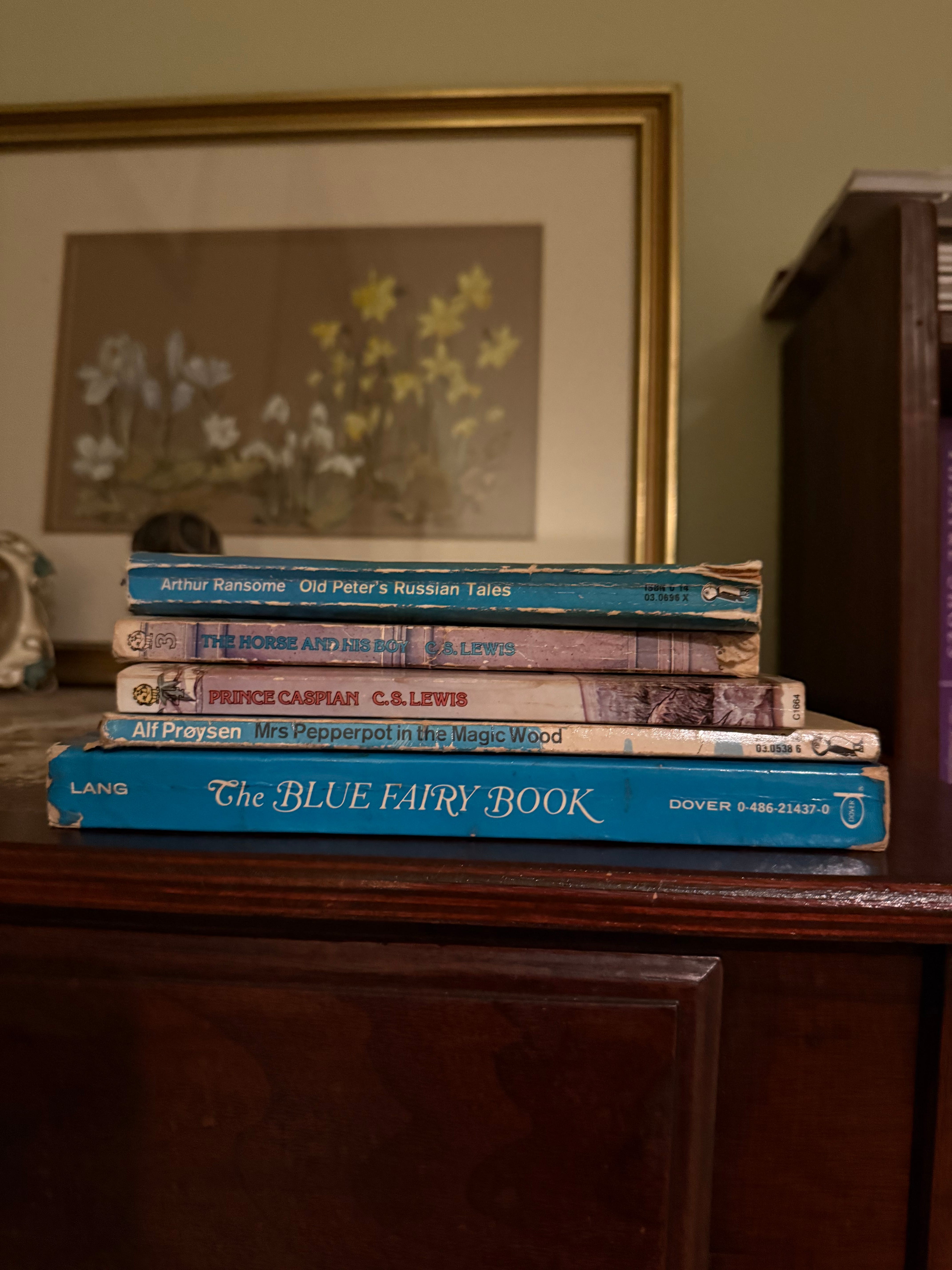
The other marvellous thing those perfectly cat sized boxes contained was fiction books. Lots and lots and lots of books, and not a wretched Peter and Jane and Pat the Sodding Dog in sight. There was Charlotte’s Web, the first book I ever cried over. The Railway Children and Mrs Pepperpot and Pippi Longstocking and Old Peter’s Russian Tales and The Blue Fairy Book and so many more. And so I read and read and read. I had always loved reading, as was evidenced by my refusal to dumb down to Peter and Jane, when I could have been foiling smugglers on Kirrin Island with Julian and co, or travelling the prairies in a covered wagon with the Ingalls girls. Stories, other worlds, other places, all captured and fascinated me. But one book took to me to somewhere else altogether.
One afternoon, I shoved a cat aside, pulled a random book out the orange box and exited the school room, as was my wont. I didn’t always climb trees or go in search of sugar. Some days I stayed on the roof, but climbed the ladder at the side of the school room that led to it’s roof, and from there up a second ladder onto the top of the water tank that sat above the school room. It was the perfect hiding place from everyone, and my favourite reading spot, as no one ever disturbed you there.
I settled down with my book, and began to read. It was The Lion, the Witch and the Wardrobe. I came down from the top of the water tank at dusk, when I could no longer see to read to find everyone in a panic and a search party being hastily organised, as no one knew about my secret spot.
I had been deep in Narnia with Lucy and Edmund and Peter and Susan, thwarting the White Witch, supping with the Beavers, weeping over Aslan, crunching through crisp snow to Mr Tumnus’s cave in an overlong fur coat, even though I had very little idea of what snow would actually feel like. I had not heard my mother shouting up the stairs that Ralph and Amanda were here for me; nor had I heard them calling me as they hunted round our usual haunts in the garden. I had not heard my mother summons me to dinner, nor my father come home and bellow for me to stop playing silly beggars and come out of wherever I was hiding, or THERE WOULD BE TROUBLE. I had heard nothing, for all I heard was the White Witch’s sleigh dashing over the snow, and the cries of the battle, and the roars of the lions. I hadn’t been reading about Narnia. I had been there, in a frozen land of ice and snow, not lying on a hot, dusty African rooftop. Obviously, this explanation did not go down terribly well with my parents, who had been getting quite concerned by 1980s standards.
And that is the magical, amazing thing about books, especially when you are a child. They can take you to places that no screen ever can, they can feed your imagination in ways no game or app could begin to, they can transport you in a way that almost feels physical.
I did some school events last year, with my Young Adult novel Lila MacKay Is Very Misunderstood, and one of the inevitable things asked was ‘What advice would you give a teenager who wants to become a writer?’ and it was the same advice I would give any teenager, regardless of what they want to be, and that is to read. Reading fuels and feeds your imagination like nothing else, and without imagination, we are nothing. Without imagination, we could not have put men on the moon, performed heart transplants, built bridges miles long, or even invented the wheel. Every single thing we have, eat, do is because someone, somewhere had the imagination to think ‘I wonder what would happen if we did this?’ or ‘If I do this, what will that do?’ And the more we read, the more our imagination sparks and burns and creates patterns and colours and ideas. Even before books, we had stories and songs and poems which served the same purpose, but now- we can read and read about anything. And it doesn’t matter what you read, as long as you read, and you enjoy it, and it makes you imagine.
So as you have possibly gathered by now, I am quite passionate about reading, and not just because books are quite literally my bread and butter. I very strongly believe that all children and young people not only deserve but actively need access to books, but even today, many disadvantaged young adults and kids simply don’t have that. Libraries are amazing, of course, and increasingly important even as they are closed at a disgraceful rate, and I always encourage everyone to use them (because otherwise you lose them), but sometimes, there is something very special about having a book of your own, particularly if it is something meaningful or important or it just made you feel that magic is real, and alive between those pages.
This is why I am so thrilled and delighted to be an ambassador for the amazing Read It Forward initiative, organised by Bookshop.org in support of the Book Trust and the Scottish Book Trust, to provide books for the children who need them the very most. And you can support it too, at no extra cost to you, because for every children’s and young adult’s book sold by Bookshop.org this February, they will donate 10% of the sale to these two amazing charities. So if you’ve been thinking of buying some books for your kids, or as gifts, or even just because, please do get behind this fabulous campaign and help get all children reading. Because after all, we need their imaginations to come up with innovative ways to look after us in our old age.
I recognise the Nairobi school teacher 😂😂😂. I always had my head in a book as did both my children, and I’m having a great time with my 16 month old grandson revisiting Peepo, Each peach etc.
I was a lonely only child and, like you, lost myself in books, even raiding my mother’s book shelves for Monica Dickens, RF Delderfield and a brilliant American author called Betty Macdonald who lived in Seattle on an island in Puget Sound. Her writing centred on the depression, with her resourceful family, and also having TB and spending a year in a sanatorium! I can’t recommend them enough! I was a precocious reader and read books way above my understanding but it didn’t matter, because I was reading!